
You know the feeling. Back-to-back meetings from 7am. A phone that never stops. Decisions stacked so deep you’ve stopped weighing them and started just getting through them.
You’re performing well, or at least that’s what the board thinks. But somewhere beneath the surface something has shifted. The instincts that once made you sharp have gone quiet. The curiosity that used to pull you toward new ideas has been replaced by obligation.
You’re still leading. But not leading well.
This is the quiet crisis running through the C-suite right now. Not the dramatic flameout or resignation letter. It’s the slow erosion of the qualities that made you effective: your energy, clarity, and willingness to take risks on things you don’t fully understand yet.
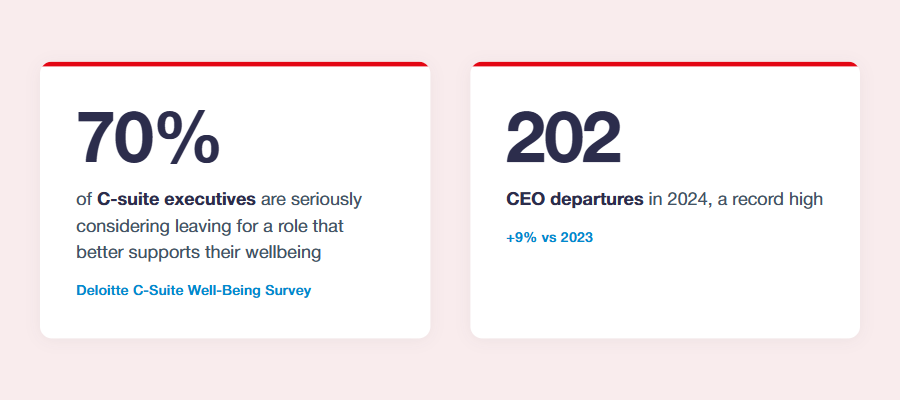
Deloitte’s C-Suite Well-Being Survey found that nearly 70% of executives are seriously considering leaving for a role that better supports their wellbeing. Meanwhile, CEO departures hit 202 in 2024, up 9% from the previous year.
When Danny Fortson told over 600 leaders during our Speed of Light session that the “Magnificent Seven” tech giants created $11 trillion in market value since 2023 with near-zero headcount growth, you could feel the room recalibrate.
The pace of change isn’t a talking point anymore. It’s reality. And the question it forces is uncomfortable: are you equipped to lead at this tempo, or are you running on fumes hoping nobody notices?
What if the bravest leadership move right now isn’t pushing harder? What if it’s stepping out?
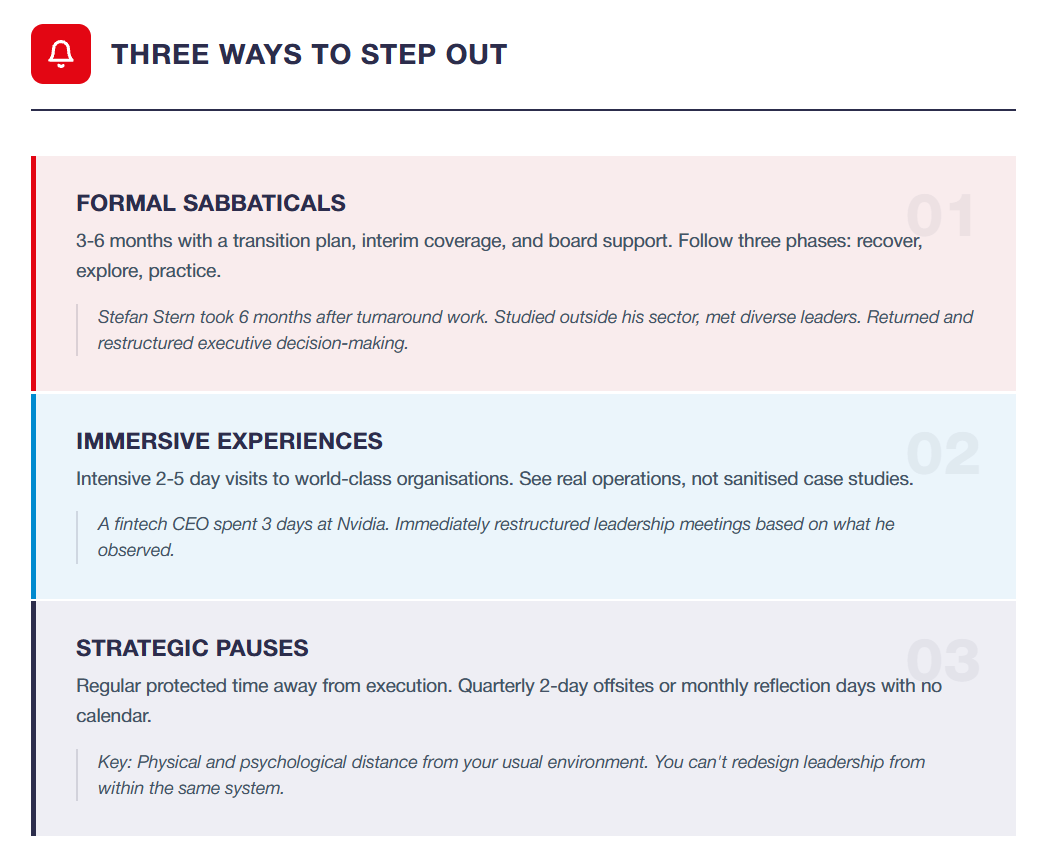
What stepping out actually means
Let’s be specific. Stepping out isn’t quitting or disengaging. It’s creating intentional distance from the daily grind to reset your leadership operating system.
What these have in common: physical and psychological distance. You can’t redesign your leadership from within the same calendar, pressures, and echo chamber. Pattern changes happen when you create space to see your role from the outside.
What are we actually measuring?
Most leaders can recite their revenue, margins, headcount, and market share. These metrics matter. But they tell you what the business is doing, not how the leader is doing, or whether conditions exist for sustained performance.
The most progressive leadership thinking treats energy as a core metric. Not a soft concept, but something measurable, manageable, and central to performance. Tony Schwartz and Catherine McCarthy made the case in Harvard Business Review: the problem isn’t time. It’s energy.
As Adrian Simpson put it: “Energy is the true currency of performance.” When you run out, decision quality drops. Empathy disappears. Risk appetite collapses. The leader becomes reactive, defensive, and the bottleneck they never intended to be.
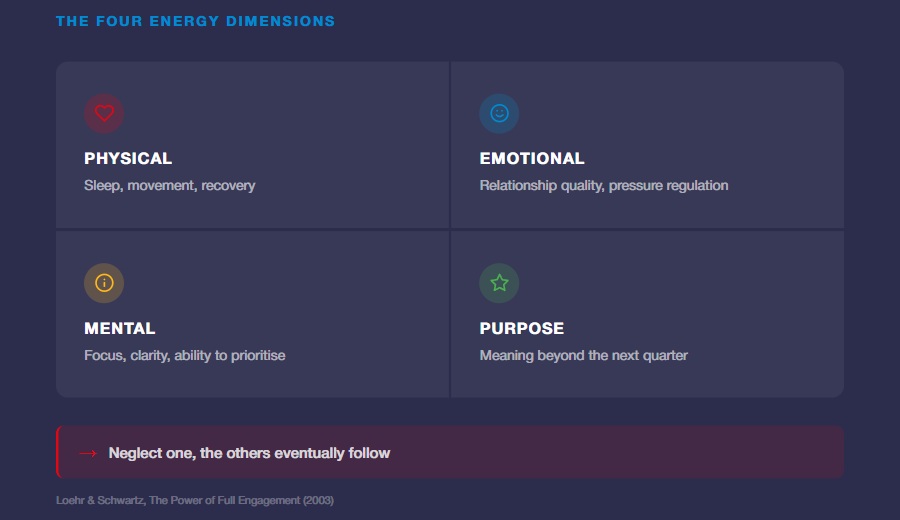
Jim Loehr and Tony Schwartz’s research identifies four dimensions that determine how a leader shows up: physical (sleep, movement, recovery), emotional (relationship quality and pressure regulation), mental (focus, clarity, prioritisation), and purpose (meaning beyond the next quarter). Neglect one and the others eventually follow.
Look at organisations leading the way. At Nvidia, every employee shares five action-based priorities weekly, scanned by AI for alignment. It’s not surveillance; it’s clarity. Everyone knows where energy should go.
At Netflix, the “Informed Captain” model puts decision-making authority with the most informed person, not the most senior. This protects senior leaders from decision fatigue while building capability across the organisation.
These companies aren’t just measuring output. They’re designing for energy and speed simultaneously.
When was the last time you genuinely felt energised?
Not caffeinated. Not busy. Energised.
If you can’t answer quickly, the gap between your performance metrics and your leadership reality is wider than you think.
The AI pressure cooker
AI has moved from experimentation to execution.
McKinsey’s 2025 State of AI report found that 88% of organisations use AI regularly in at least one function, yet only 31% have scaled it enterprise-wide. Bain’s research tells a similar story: 74% of companies rank AI as a top-three priority, but only 23% can tie their initiatives to measurable revenue or cost impact.
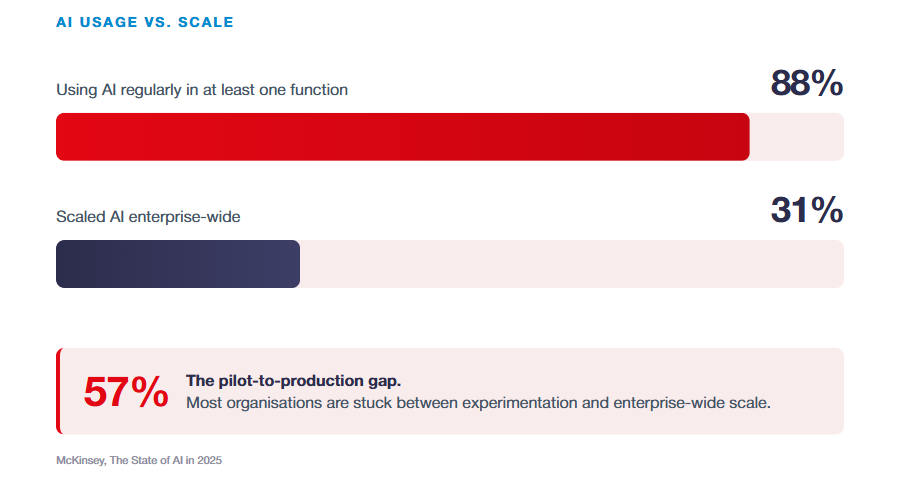
The pilots are over. The stakes are real. Leaders are carrying extraordinary weight: AI strategy, data governance, workforce anxiety, regulatory uncertainty, and their own learning curve on technology that reinvents itself every few months. All at once.
Zoe Scaman put it plainly: stop treating AI as an add-on efficiency tool. It’s “a new organising principle for business.” That’s not an operational upgrade. That’s a fundamental rethink of how your organisation creates value, serves customers, and competes.
Here’s the irony nobody talks about enough: burned-out leaders create exactly the conditions where AI adoption fails.
When a leader is exhausted, they become defensive. Defensive leaders kill psychological safety, the shared belief that a team is safe for interpersonal risk-taking. Without psychological safety, teams won’t experiment. Google’s Project Aristotle study confirmed it as the single most important factor in team effectiveness.
Without experimentation, AI initiatives stall. MIT research found that 95% of generative AI pilots fail to deliver ROI beyond the pilot phase.
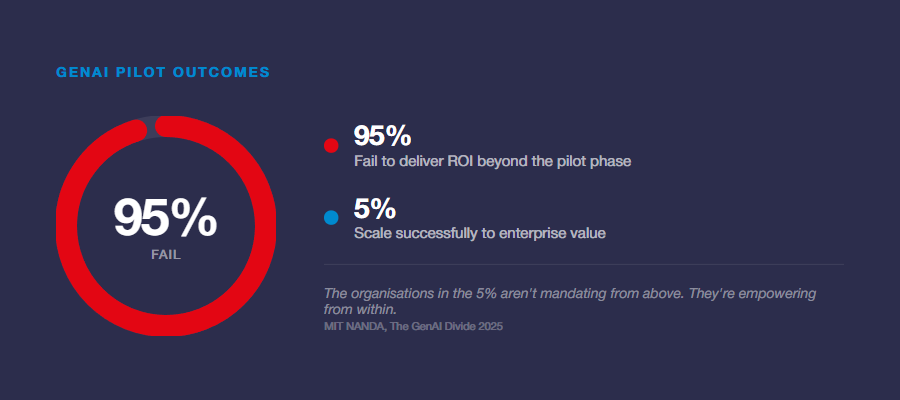
Burned-out leaders create exactly the conditions where AI adoption fails.
The organisation falls behind. The leader gets blamed. The burnout deepens. It’s a loop running in boardrooms everywhere.
Zoe (Scaman) shared a striking finding: top-down AI rollouts rarely exceed 30% adoption. The organisations getting it right aren’t mandating from above. They’re running listening tours. They’re empowering super users. They’re creating safe spaces where people can try, fail, learn, and try again.
That requires leaders with the psychological bandwidth to hold uncertainty, sponsor experiments that might not work, and say publicly, “We’re figuring this out together.”
Here’s the permission too few leaders give themselves: it’s okay to experiment. It’s okay for a pilot to not scale. It’s okay to restructure, rethink, and redeploy. That’s not failure. That’s the process.
But you can’t lead that culture from depletion. Leaders who make bold bets on AI aren’t white-knuckling through burnout. They’ve created enough psychological space to tolerate the ambiguity genuine innovation demands.
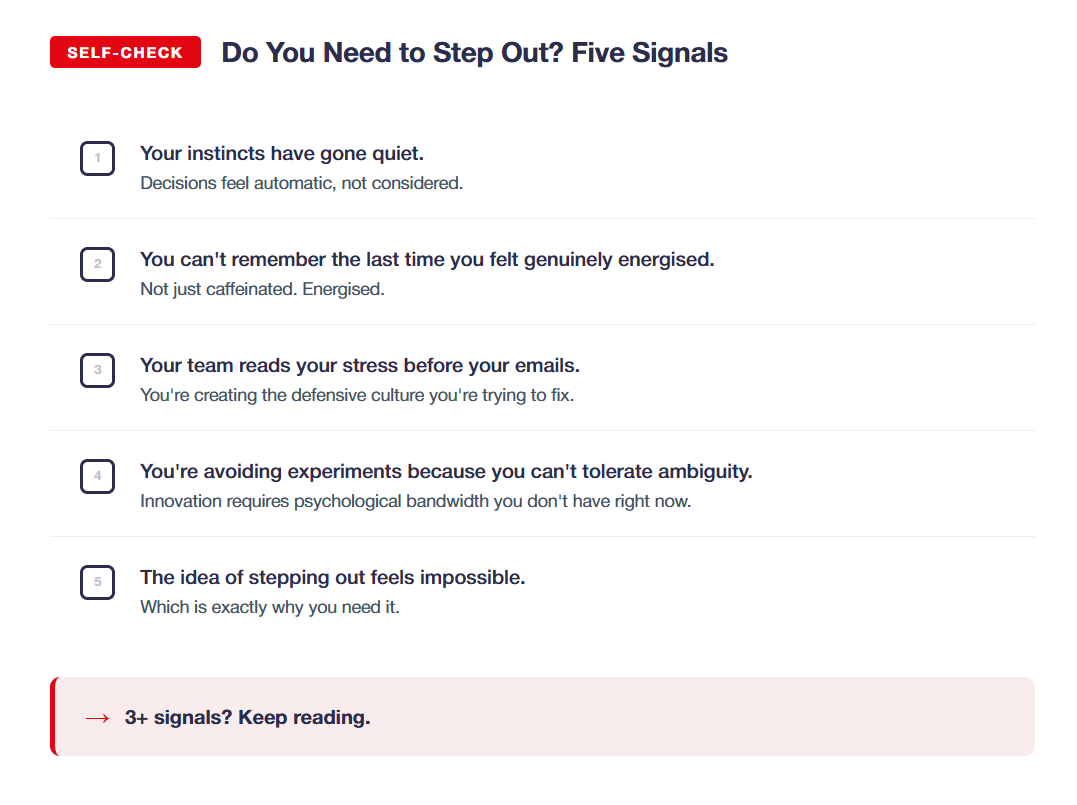
When stepping out is the wrong move
Let’s be honest about what doesn’t work. Stepping out isn’t always the answer, and it’s not available to everyone the same way.
If you’re in a genuine turnaround, three months out might sink the business. If you’re a founder in year two, a sabbatical could break momentum at the wrong time. If you lead a public sector organisation with no succession plan in a political environment that views absence as weakness, stepping out could be career suicide.
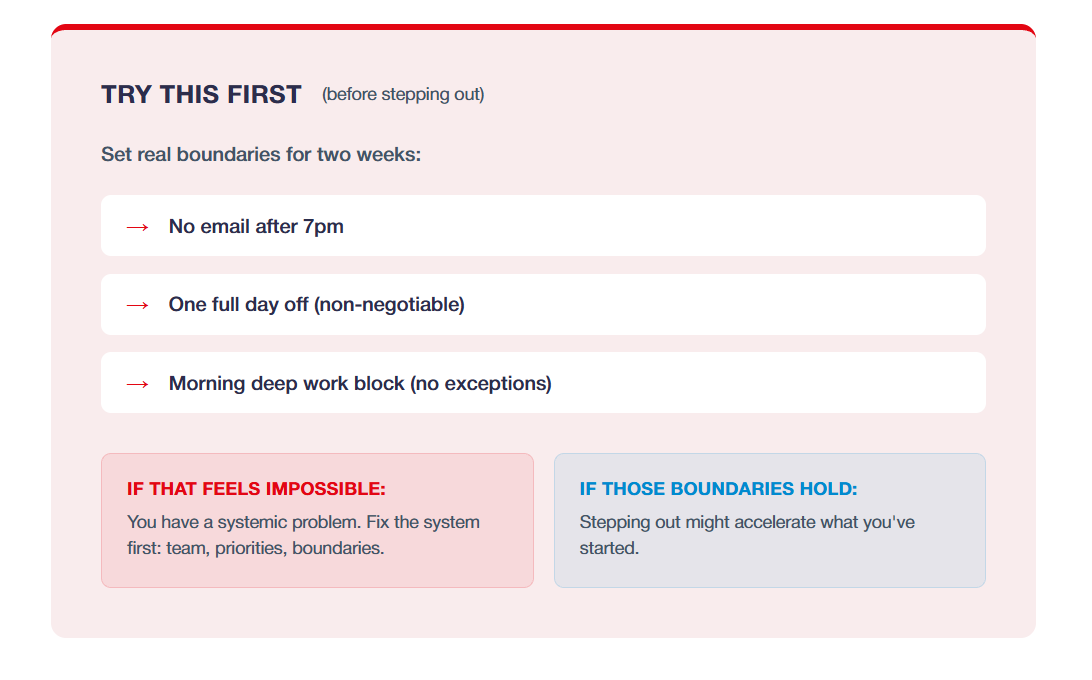
Sometimes the problem isn’t you; it’s the system. If your board keeps adding contradictory objectives, if your executive team is dysfunctional, if the business model is broken, personal renewal won’t fix structural problems. You might need different boundaries, a clearer mandate, or an honest conversation about whether this role is doable.
And here’s the uncomfortable truth: some leaders use stepping out as avoidance. Taking a sabbatical because you can’t face a difficult conversation with your CFO isn’t strategic renewal. It’s procrastination with better branding.
Leaders who benefit most from stepping out are those giving everything to a role that matters, not those looking for an exit ramp they won’t name honestly.
Connection as strategy
In all the noise about AI, digital transformation, and performance metrics, we risk forgetting something fundamental: we are social animals.
Michael Tomasello’s research describes humans as “ultra-social animals” whose brains evolved for group living, shared attention, and collaboration. Roy Baumeister and Mark Leary’s study established that the need to belong is one of the most powerful human motivations, shaping cognition, emotion, and behavior.
These drives don’t switch off when you become a CEO. They intensify. The higher you go, the fewer people truly understand what you’re navigating.
The loneliness of senior leadership is real and worsening. A study of over 61,000 workers found that remote work caused collaboration networks to become more siloed, with cross-group collaboration time dropping around 25%.
The informal moments that built trust (corridor conversations, shared lunches, unscripted debriefs after tough meetings) have diminished. Leaders are more connected digitally and more isolated humanly.
That isolation doesn’t just feel bad. It degrades performance. Leaders without trusted peers make narrower decisions, take fewer risks, and lose touch with the emotional temperature of their organisations.
This is where stepping out becomes strategic. The most effective leaders we work with don’t step out to disconnect; they step out to reconnect differently. They use distance to rebuild their “personal boardroom”: a curated group of peers, mentors, and provocateurs from outside their sector who’ll challenge their thinking and share what’s actually happening, not the polished version.
Here’s what that looks like. During our China immersion trip last year, one CEO spent an evening in conversation with the founder of an AI startup and a logistics director from a different industry. They weren’t networking transactionally.
They compared notes on workforce transformation, shared failures around digital adoption, and pushed each other on assumptions they’d stopped questioning. Two months later, that CEO restructured his approach to operational automation based on insights from the logistics conversation. He didn’t copy a playbook. He was inspired by a mental model that unlocked a problem he’d been working on for months.
That’s the real value of stepping out: exposure to different contexts that reveal your blind spots. You can’t get that from your executive team. They’re inside the same system. You can’t get it from consultants selling a methodology.
You need peers navigating similar pressures in different environments who’ll tell you the truth because they’re not competing with you or trying to sell you something.
And energy is contagious. How you show up shapes your team’s climate. Calm or frantic. Curious or defensive. Open or closed. Your team reads your energy before your emails. You can’t hide depletion, and you can’t fake renewal.
Leaders who invest in stepping out don’t just come back better for themselves. They come back better for everyone around them because they’ve reconnected to something bigger than quarterly targets: a sense of possibility and the peer relationships to help them get there.
Where do you get your energy?
This is the personal question, and it matters most. Where do you actually get your energy? Not in theory. Not what you’d put in a wellness policy. Right now, in your life, what fills you up and what drains you?
And are you structuring your days, weeks, and year to protect what sustains you? Or have you let the role consume everything and called it commitment?
Wellbeing isn’t a perk. It’s a leadership strategy. Burned-out leaders create stressed cultures, make poor decisions, and drive higher turnover. Organisations increasingly recognise this, which is why investment in executive coaching and wellbeing programs is growing.
But the real shift must come from the leader: the decision to treat your energy as something you design, not something you leave to chance.
The highest-performing leaders we see share a common trait: they’ve built systems around their energy. Morning routines with movement or reflection. Fixed blocks of deep work where the phone goes off and the calendar stays empty. Boundaries around evenings and weekends that aren’t negotiable. Intentional time with family, mentors, or peers who provide perspective and emotional support.
These aren’t luxuries. They’re the architecture of sustained performance.
At Webmart, meeting rooms display a real-time cost ticker showing what the meeting is costing the business as it runs. It’s a simple design intervention that prompts faster decisions and shorter meetings. That’s not just design for speed; it’s design for energy. Every unnecessary meeting drains energy.
The best organisations structure their environments to protect their people’s most valuable resource.
But here’s the deeper insight: significant pattern changes rarely happen inside the existing system. You can’t redesign your leadership from within the same calendar, pressures, and echo chamber.
Leaders who make lasting shifts almost always do it by stepping out first: a sabbatical, a curated immersive experience, a trip somewhere genuinely unfamiliar. Physical and psychological distance from the daily grind creates space to reflect on what kind of leader you want to be next. Not just refreshed, but fundamentally recalibrated.
The breakthrough
If you’re reading this and recognising yourself, here’s what we know from working with hundreds of leaders navigating this transition. The breakthrough isn’t a single dramatic moment. It’s a series of decisions.
The decision to measure what actually matters, not just what’s easy to count. The decision to manage your energy as deliberately as you manage your P&L. The decision to lead AI adoption with curiosity and humility rather than fear and control. The decision to invest in human connection as fiercely as you invest in strategy.
And the decision to step out, intentionally, before the system makes the choice for you.
We closed our Speed of Light session with a challenge:
“The companies that act now will write the playbooks that others follow.”
The same is true of individual leaders. Those who invest in their reset now will lead the next chapter with more clarity, energy, and impact than those who keep pushing until something breaks.
Stepping out isn’t retreat. It’s preparation for a more powerful return.
It’s the choice to bring the outside world in before the inside world burns you out. And it’s available to you right now, if you’re ready to take it.
The question isn’t whether you need it. It’s whether you’re ready to step into it.